GCMS Analysis
The results were analyzed using a mass spectrometer running Xcaliber
software and a gas chromatogram with a DB-5 column. This equipment is
commonly referred to as a GCMS (gas chromatogram mass spectrometer).
The products exited the reactor and were immediately injected into the
GCMS to obtain the chemical make-up of the product. The product was
then separated into samples for further evaluation.
Results from Sugar Beet Pulp
Sugar beet pulp, which consists of cellulose, hemicellulose, pectin
and some residual sugar, was processed and the resulting product was
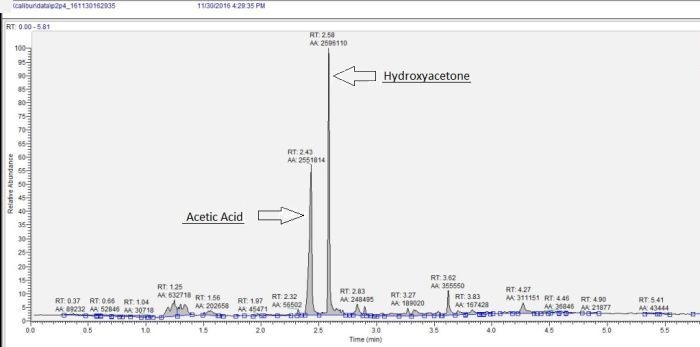
then analyzed. The GCMS results are shown in Figure 1. The x-axis is
the time that each chemical exits the gas chromatogram. That chemical
is then measured and identified by the mass spectrometer. The lightest
chemicals come out first and the chemicals show up as the grey peaks
in the figure. The size of the peak is a measurement of the amount of
that chemical in the product. The larger the peak, the larger the
amount of that chemical in the product. For the beet pulp the primary
products are hydroxyacetone and acetic acid, which are identified in
the figure.
Figure 1. Results from sugar beet pulp.
Results from Sugars and Starches
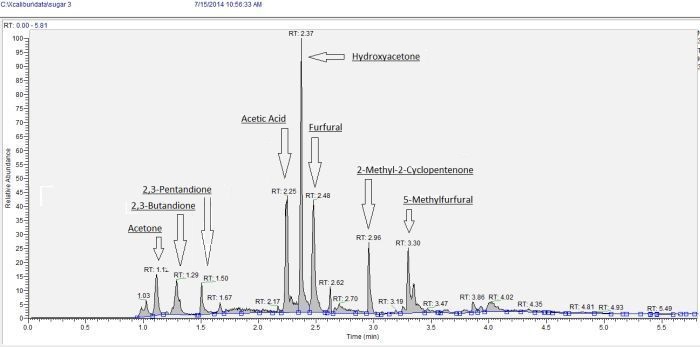
Sugars and starches all produce similar results. When they're
processed the results look like those in Figure 2. Hydroxyacetone and
acetic acid are again the largest products but substantial amounts of
acetone, furfural, cyclopenteneone and methyfurfural are also in the
product.
Figure 2. Results from sugars and starches.